
Conversation

Read Every AI Conversation, Voice and Chat

Amernet Conversations is where every call and every chat your AI agents handled is kept — transcript, recording, and what actually came of it.

Calls and chats sit in one place regardless of where they happened: the phone, the website widget, Slack, Telegram or WhatsApp. One history, not one per channel.

And each call is reviewed automatically — when one goes wrong, you are pointed at the turn where it went wrong, not left to listen through the whole thing.
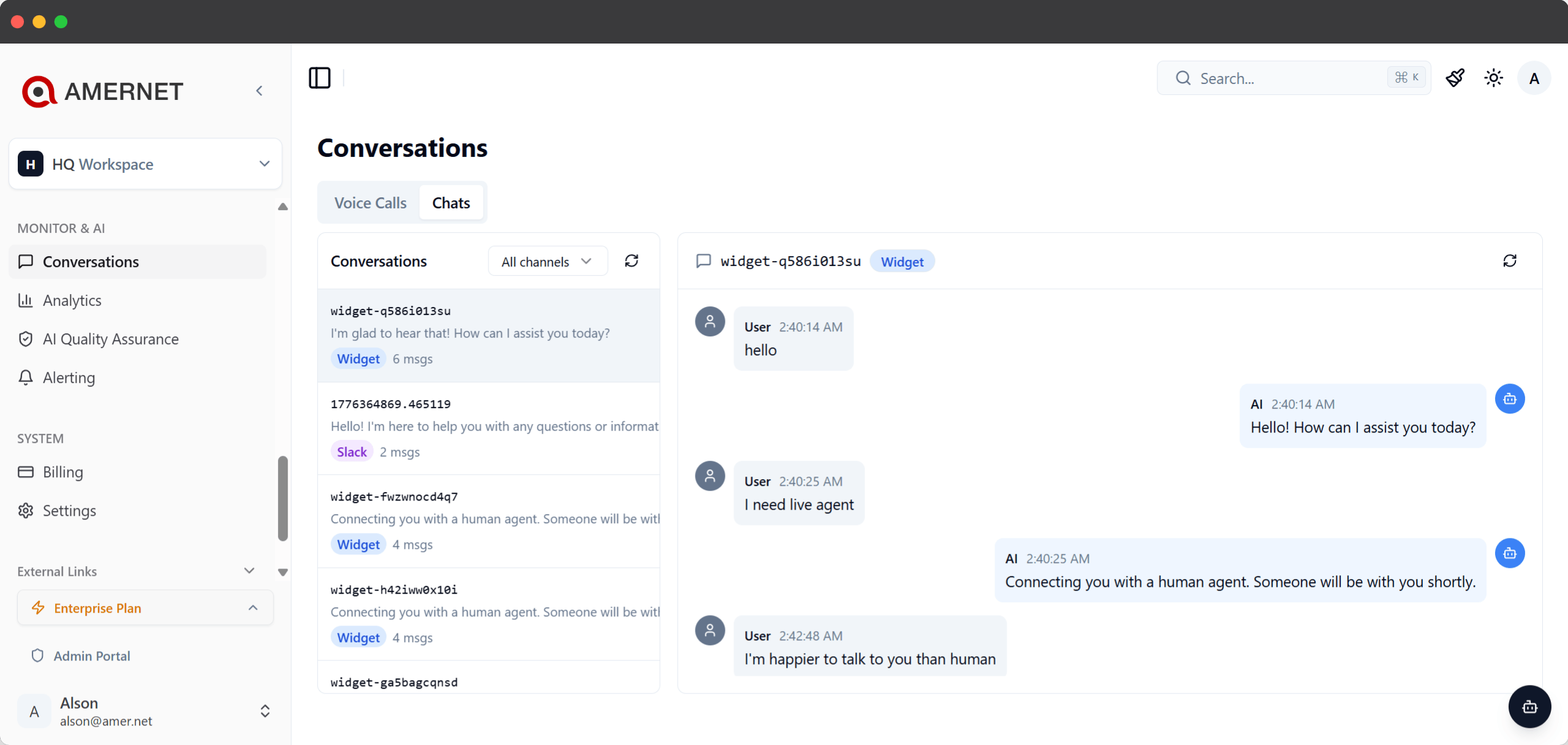
Conversation - Chats
The record

What Conversations actually holds

Every call and chat, readable after the fact.

Voice calls keep their transcript and recording alongside the duration, the cost, the sentiment reading and how quickly the agent was responding. You can read a conversation back rather than guess at it from a summary.

Chats are kept the same way, whichever channel they arrived on — the website widget, Slack, Telegram or WhatsApp all land in the same list.

This matters most in the first weeks of running an agent, when the question is never “how many calls” but “what is it actually saying to people”.

Being able to read fifty real conversations is what turns a set of agent instructions from a guess into something tuned.

What you can do

Six things you can do with the record

Beyond scrolling a list of calls.

Read it or listen to it

Full transcript and recording for every call, so you can check exactly what was said rather than rely on a summary.

Every channel in one list

Phone calls and chats from the website widget, Slack, Telegram and WhatsApp sit together instead of in separate silos.

Did it reach a human?

Each call records whether it actually reached a person, or whether it met an IVR, a voicemail greeting or another answering system.

The exact turn it went wrong

When a call fails, the review points at which turn broke it and why, instead of leaving you to listen through the whole recording.

Rules it was supposed to follow

If an agent broke one of its own rules during a call, that is recorded against the call rather than discovered by accident.

Patterns, not just calls

Individual conversations roll up into the numbers, so a recurring objection stops being an anecdote and becomes something you can act on.

The review

Every call gets a second listen

Automatically reviewed, so the bad ones surface themselves.

Nobody listens to every call. That is the whole problem with quality on a phone team, and it does not improve just because the agent is software.

So every call is reviewed automatically. The review records what the agent was actually talking to, whether it got through to a person, a short summary of what happened, and — when something went wrong — the specific turn where it started going wrong and the reason.

That turns a pile of recordings into a short list worth your attention. Instead of sampling calls at random and hoping you catch the bad one, the bad ones raise their hand.

It is also how you find out that an agent has been mishandling one specific question all week.

Questions

Common questions about Conversations

What people ask about the conversation record.

Yes, with the transcript beside it, plus duration, cost, sentiment and the agent’s response times. Any call can be read or played back in full.

No. Calls and chats sit in the same place, and chats from the website widget, Slack, Telegram and WhatsApp all land in one list rather than one per channel.

Every call is reviewed automatically. When one fails, the review names the turn where it went wrong and why, so problem calls surface instead of having to be hunted for.

Yes. Each call records what it actually reached — a person, an IVR, a voicemail greeting or another answering system — so your connection figures mean what they say.

Rule violations are recorded against the call, so they are visible in review rather than found by chance later.

Conversations is the individual record; analytics is the same material summarised — volume, response times, sentiment, per-agent performance and cost.

Read your own conversations

Run some real calls and go through them together.

Book a short session, put an agent on real calls, and we will read the transcripts together — including whichever one went worst, which is usually the most useful half hour of the evaluation.